I lead site execution, coordinate teams and turn complex information into clear priorities. My background combines over 10 years of practical construction experience with site supervision, professional football analysis and digital tools developed around real operational challenges.
Freelance site management · Project coordination · Project control Rotterdam, Netherlands · ZZP & project contracts
Escalators & moving walks, alongside the lift scope
A-Pier delivery milestone
All units delivered and Cause & Effect testing completed ahead of the handover phase scheduled for 18 December.
What I bring to a project
I understand the physical work, the people carrying it out and the information needed to keep it moving. That combination shapes the way I take responsibility on site.
Construction judgement grounded in execution
My experience began with the work itself: carpentry, fit-out, renovation and infrastructure. That practical foundation helps me assess how a task can actually be built, identify constraints early and discuss solutions credibly with the people responsible for execution.
Leadership across teams and companies
I organise people around clear priorities, practical instructions and visible responsibilities. At A-Pier, this has included coordinating up to 40 people across seven simultaneous teams, bringing different contractors and international working styles into a shared delivery sequence.
Planning that accounts for site reality
I connect the programme with labour capacity, materials, access, work areas and inspection availability. I look beyond the planned date to the conditions needed to achieve it, then adjust priorities as dependencies change.
Coordination through technical interfaces
Mechanical, electrical and construction activities often depend on one another. I make those interfaces explicit, clarify who needs to act and follow issues through with the relevant parties so that an unresolved dependency becomes a concrete next step.
Analytical thinking applied to delivery
I use structured data to understand workload, capacity, recurring defects and progress. Professional football analysis and live match-data work add practical analytical experience alongside my background in Excel, SQL, Python and Tableau.
Closure supported by evidence
I keep completed work, inspection readiness, test results and verified closure distinct. Photographs, finding references and clear records help connect execution with the checks and documentation required for the next stage of delivery.
THE CONNECTION BETWEEN THESE SKILLS
Close to the work. Clear about the bigger picture.
I have worked on railway infrastructure, commercial renovation, building and fit-out assignments, international data centre projects and airport construction. Across those environments, my contribution has grown from practical execution into organising teams, coordinating interfaces and taking broader responsibility for delivery.
I am comfortable moving between a discussion on site, a planning review and a detailed progress overview. Each gives a different part of the picture. Bringing them together helps me make decisions that reflect both the immediate work and the project’s next milestone.
My selected work combines construction delivery with professional football analysis and live sports data. The projects show my practical responsibilities, analytical work and the different environments in which I have contributed.
Airport infrastructure2025–present
A-Pier Schiphol
Schindler · main contractor BAM · Netherlands
Site supervision & final-phase delivery
Coordination of people, materials, inspections and technical interfaces, including up to 40 people and seven teams simultaneously. A practical example of my progression into broader responsibility and the use of data to support close-out.
Daily work organisation alongside practical execution on walls, ceilings and technical rooms. International teamwork, drawings, specifications and coordination with adjacent trades shaped the experience.
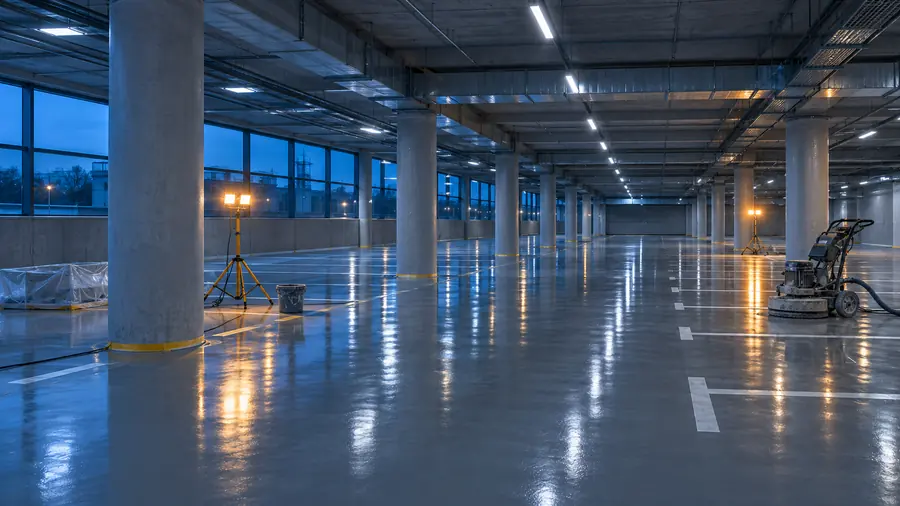
I led the team on renovation, epoxy-flooring and concrete-repair projects in parking facilities and commercial buildings — responsible for planning, task allocation, capacity, execution quality and day-to-day contact with the client.
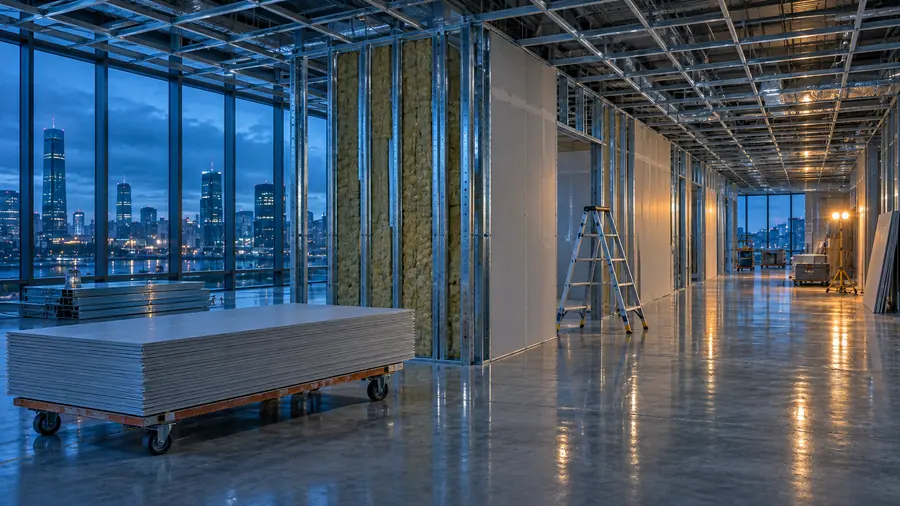
As an independent contractor I delivered fit-out, insulation, assembly and renovation scopes on projects for BAM, VolkerWessels, Heijmans and Strukton — taking ownership of planning, materials, quality and coordination with the surrounding trades.
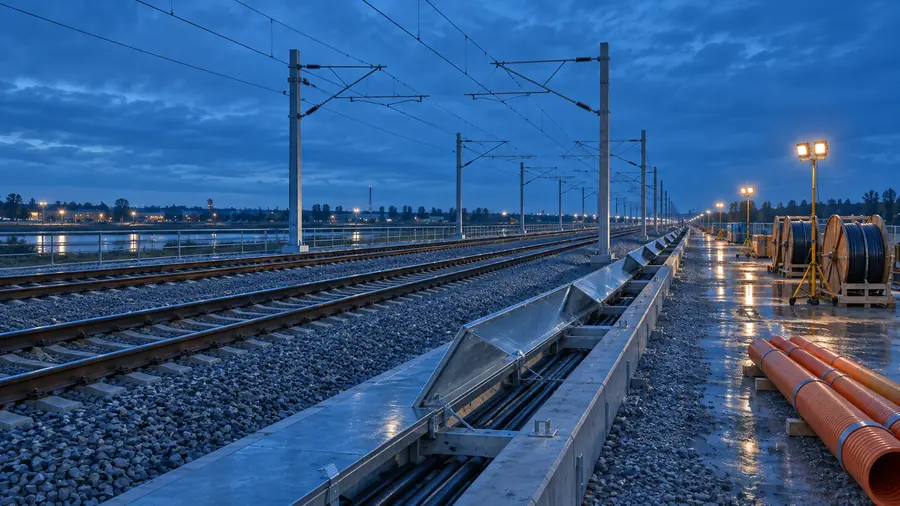
Team supervision and coordination of cable and piping installation work, following technical drawings and specifications while maintaining attention to safety, quality and progress.
Professional analysis in another demanding environment.
Alongside construction, I have worked in club opposition analysis, analytical work for football agencies and live sports data. These assignments show how I investigate performance, communicate findings and maintain the quality of information.
Club opposition analysis2024–2025
FK Pardubice
Opposition Analyst · September 2024–July 2025
Understand the opponent. Support preparation.
Opposition-analysis work alongside a data analyst, with StatsBomb data informing research into opponents and their playing patterns. The wider analytical work also included youth-integration research using Transfermarkt.
Bringing people, technical interfaces and delivery information together during the final project phase.
Schindler Liften · main contractor BAMAmsterdam Airport Schiphol, NetherlandsJoined September 2025 · Uitvoerder responsibilities in 2026
COORDINATION SCOPE
up to40
People
7
Simultaneous teams
44
Escalators & moving walks, alongside lifts
THE ASSIGNMENT
Turn the remaining work into a deliverable sequence.
I took on broader site-supervision and coordination responsibilities during the final project phase, with the objective of getting the equipment delivered ahead of the planned handover phase. The work required more than a list of outstanding tasks: people, materials, access, technical work, inspections and testing all had to connect.
My role covered the daily organisation of execution within the Schindler scope and coordination with the surrounding project environment. I worked across international teams and subcontractors, aligning practical work with the requirements and interfaces involving Schindler, BAM and Schiphol.
People & work planning
I organised daily and weekly priorities, allocated available people and coordinated the sequence between teams. The plan had to reflect which tasks were ready to start, which depended on other work and which needed specialist support before an inspection or test could proceed.
Materials, access & dependencies
I followed material availability, access arrangements and practical blockers alongside the work itself. A planned activity only becomes executable when the people, equipment, materials and working conditions are available together.
Technical interfaces
I coordinated construction, mechanical and electrical interfaces and clarified the next action with the relevant parties. This included distinguishing contractor work from construction dependencies and documentation points, keeping responsibilities visible during close-out.
Inspections & testing
I coordinated inspection preparation, SAIS and Re-SAIS activities, NEN1010 follow-up and the work needed around technical testing. Inspection slots and specialist availability became planning constraints, with open points and prerequisites followed through before the next appointment.
HOW I SUPPORTED CONTROL
One asset can have several different states of readiness.
An installation can be physically finished while a test, inspection point or document is still outstanding. I used asset-level tracking to keep those conditions visible separately: execution status, inspection readiness, software, technical tests and outstanding findings.
The A-Pier dashboard brought those views together. Separate responsibility streams, asset references, inspection records and progress reports gave me a structured way to prepare priorities and explain what still required action. Repeated findings could also be grouped by type, helping turn a long list into a more practical work package.
For resource discussions, I used workload and capacity overviews to make the implications of staffing and available time explicit. These planning views supported decisions while keeping dependencies such as material delivery, access, rework and inspection availability in the picture.
Delivery milestone achieved
All units delivered and Cause & Effect testing completed before the handover phase scheduled for 18 December. This describes the equipment-delivery and testing milestone ahead of the formal handover phase.
What this project demonstrates
The ability to step into a demanding delivery phase, organise several teams at once and connect practical execution with structured project information. It also shows how I use digital tools to make responsibilities, readiness and the next action easier to understand.
Team coordination and practical technical fit-out in a large international construction environment.
Takakustik · Stockholm region2023–August 2025Team coordination & practical execution
Coordinating a team while staying close to execution.
On Amazon Web Services data centre projects in Sweden, I combined practical construction work with coordinating one of the teams. The work focused on interior walls, ceilings and technical rooms, within an environment where several contractors and disciplines needed to align.
My day-to-day contribution included organising the team’s activities, following the relevant drawings and specifications, checking progress and coordinating the immediate interfaces with other site teams. Remaining involved in execution gave me a direct view of the conditions affecting the work.
Daily work organisation
I translated the available scope into tasks for the team and aligned the sequence with the situation on site. The aim was to give people clear work to carry out while keeping dependencies with adjacent activities visible.
Drawings & specifications
Walls, ceilings and technical spaces had to be built in accordance with project requirements. Reading drawings and checking the practical details formed part of daily execution and quality awareness.
International coordination
The project environment required communication across different companies and working backgrounds. Clear instructions and regular alignment helped connect our own work with the activities taking place around it.
Quality, safety & progress
I followed the team’s progress and the quality of execution while working within site safety requirements. Practical issues needed to be identified early enough for the team and surrounding trades to respond.
Experience I carried into site supervision.
This period strengthened the connection between doing the work and organising it. It developed my ability to coordinate in a technical, international setting while maintaining the practical awareness needed to understand what a team can achieve under actual site conditions.
It also broadened my construction experience into data centre fit-out — a relevant foundation for future assignments involving technical buildings and demanding interfaces between construction and installations.
Responsible for the team, the planning and the result.
During my assignments with TVB Utrecht, I led the team carrying out renovation, epoxy-flooring and concrete-repair projects in parking facilities and commercial buildings. Working as an independent ZZP professional, I was responsible not only for the execution itself, but for how the work was organised and delivered.
My role covered planning the work, allocating tasks within the team, matching the available capacity with the scope, monitoring execution quality and acting as the point of contact for the client and other parties around the project.
Planning & work allocation
I translated each assignment into a workable sequence and a clear plan for the team. Decisions about the day’s work reflected the people available, the condition of the working area and the requirements of the materials being applied.
Leading the team
I gave the team clear instructions, divided the work and kept the activities aligned with the plan. Staying involved on site meant I could adjust quickly when conditions changed and keep progress moving.
Quality responsibility
I followed the quality of the work as it progressed and took responsibility for the result delivered to the client. A logical sequence and attention to preparation were essential to a durable finish.
Client coordination
I communicated with the client about progress, next steps and conditions affecting the planning, connecting their expectations with what the team delivered on site.
What these projects demonstrate.
Leading a team as an independent professional, with responsibility for planning, capacity, quality and the client relationship. These projects strengthened the project-management skills I later applied on larger technical projects in Sweden and at Schiphol.
OWN BUSINESS · BUILDING · RENOVATION · INFRASTRUCTURE
Independent construction contractor
Five years running my own ZZP business — taking ownership of scope, planning and quality on projects for major contractors.
Own ZZP business · via IV Totaalbouw / DeBoerNetherlands · 2017–2022Projects for BAM, VolkerWessels, Heijmans, Strukton
Responsible for my own scope, from agreement to delivery.
Between 2017 and 2022, I ran my own construction business as an independent ZZP contractor. Through IV Totaalbouw and DeBoer, I took on building, renovation and infrastructure assignments on projects for major contractors such as BAM, VolkerWessels, Heijmans and Strukton, covering fit-out, plasterboard, insulation and assembly scopes.
Working independently meant taking full responsibility for the work I accepted: understanding the requirements, planning my own sequence and materials, coordinating with the trades around me and delivering a result that met the specification and the main contractor’s expectations.
Ownership of the scope
Every assignment started with a clear understanding of the scope, the drawings and the conditions on site. I agreed what had to be delivered and took responsibility for the result.
Planning & materials
I planned my own work, arranged what was needed to carry it out and kept the main contractor informed about progress and anything affecting the sequence.
Coordination with other trades
Fit-out work depends on the activities before and after it. I aligned my scope with the surrounding trades so that working areas were ready and the next activity could follow.
Quality to specification
As an entrepreneur, my reputation depended on the quality of every delivery. Working to drawings and specifications on projects for major contractors built a consistent standard of execution.
The foundation for managing projects.
Running my own business taught me to think like a contractor — about scope, time, quality and the client relationship. Moving between project environments also developed a practical understanding of how trades depend on one another and how an unfinished detail affects the next activity.
My later team-lead and site-supervision roles build directly on that mindset. It helps me assess a proposed sequence, understand why progress has stopped and keep coordination connected to the realities of the work.
Early responsibility for people, technical execution and the daily organisation of infrastructure work.
Oers · Netherlands2014–2017Foreman · team supervision
Learning to organise work through people.
At Oers, I worked as a foreman on cable and piping systems for railway infrastructure. My responsibilities included daily team supervision, organising activities and coordinating the work with the site environment.
Execution followed technical drawings and specifications, with attention to safety, quality and progress. The role combined practical understanding with the need to give people clear direction and keep the team’s work aligned with project requirements.
From individual tasks to team output
This was an early foundation for my leadership experience. Coordinating a team required me to consider the whole activity: what needed to happen, who was available, how the tasks connected and what had to be checked as the work progressed.
What remains relevant today
The habits developed here — clear work allocation, awareness of interfaces and consistent attention to execution — remain part of my approach to larger construction and technical projects.
Opposition analysis and football research supporting a more informed understanding of the game.
Role: Opposition AnalystSeptember 2024–July 2025Collaboration alongside a data analyst
Move from match data to an understanding of the opponent.
My professional football work included opposition analysis for FK Pardubice. Working alongside a data analyst, I investigated opponents and the patterns that matter when preparing for a match.
The analytical context included access to StatsBomb data across the season and previous season, with preparation for opponents such as Sparta Prague. Looking across a wider body of matches helps put an individual performance into context and supports a more balanced interpretation of the opponent.
Opposition understanding
The purpose of an opposition brief is to turn research into a usable picture of the team: its identity, attacking and defensive tendencies, transitions, influential players and the situations that deserve attention in preparation.
Data interpretation
I connect the figures with the football question behind them. The task is to understand what a pattern suggests, which context could affect it and how clearly the finding can be explained to the reader.
Youth-integration research
My work also included a 2024/25 youth-integration report for FK Pardubice. Using Transfermarkt, the research examined U20 and U23 starts and minutes, academy participation and comparison with the wider league.
Clear reporting
The report needs to connect its conclusions with the supporting information and make the relevant patterns easy to follow. This requires structure, selective emphasis and an explanation of what the data can reasonably support.
What this work demonstrates.
Professional experience with analytical research, football-specific interpretation and the communication of findings. It complements my construction experience by showing the same discipline in another context: understand the situation, structure the information and make the next decision clearer.
Analytical work and reporting in a commercial football context.
Professional agency workResearch · data interpretation · communication
Make analytical information useful to the person reviewing it.
My football experience also includes work for agencies. This adds a commercial football perspective to my analytical background and brings research, interpretation and reporting into the same workflow.
Start with a clear question
I organise analytical work around the question the reader needs to examine. A useful report needs a defined purpose, relevant information and a clear connection between the evidence and the conclusion.
Keep context visible
In football analysis, comparisons need to account for the context behind the figures. I pay attention to what the available information describes, how comparable the records are and which conclusions require further evidence.
Communicate the reasoning
My aim is to produce material that the reader can follow, with a clear structure and understandable interpretation. This connects my technical analytical training with practical communication in a professional setting.
Following the game in real time and maintaining the quality of the recorded information.
2025Role: StatisticianFootball & ice hockey
Data quality begins at the point of observation.
During 2025, I worked as a statistician for Genius Sports, reporting live football and ice-hockey match data. The work required following events as they happened and recording the relevant information accurately and on time.
Live observation and reporting
A live match places the work under immediate time pressure. Attention, consistency and an understanding of the sporting context are important when translating what happens on the field into structured records.
Accuracy and timeliness together
The role reinforced the importance of reliable source information. Downstream analysis depends on the quality of the underlying data, so the way an event is observed and recorded matters before any dashboard or report is produced.
What I carried forward
This experience strengthens the operational side of my analytical work: disciplined observation, clear classification, concentration under time pressure and an awareness of how individual records contribute to a larger information system.
My career combines leading teams, running my own construction business, foreman experience and site supervision. Analytical training adds another way to understand the work and support decisions.
2025–present
A-Pier Schiphol · Site supervision & coordination
Schindler Liften · main contractor BAM · Netherlands
Joined in September 2025, progressing into Uitvoerder responsibilities in 2026. Daily and weekly planning, international team coordination, material and access follow-up, technical interfaces, inspections and delivery preparation. Digital tracking and reporting supported the organisation of remaining work.
Coordinated one of the teams while working on walls, ceilings and technical rooms. Daily organisation, drawings, specifications, progress, quality and alignment with other teams in an international environment.
Led the team on epoxy-flooring, concrete-repair and renovation projects in parking facilities and commercial buildings. Responsible for planning, task allocation, capacity, execution quality and client coordination.
Independent construction contractor · Own ZZP business
Assignments via IV Totaalbouw / DeBoer · Netherlands
Ran my own construction business, delivering fit-out, plasterboard, insulation and assembly scopes on building, renovation and infrastructure projects for BAM, VolkerWessels, Heijmans and Strukton. Responsible for my own planning, materials, quality and coordination with other trades.
Professional analytical assignments alongside my construction career.
September 2024–July 2025
FK Pardubice · Opposition Analyst
Club analysis · collaboration alongside a data analyst
Opposition research using StatsBomb data, with additional research into youth integration, U20/U23 participation and league context using Transfermarkt.
Fire safety / fire-resistant construction and materials.
Dutch — fluent.
English — fluent.
Polish — native.
HOW I THINK & WORK
Understand the work. Make the next step clear.
My approach comes from working on site, taking responsibility for people and learning to use information more deliberately. I stay close to execution while keeping the wider delivery sequence in view.
I start with the reality on site.
Before I can organise an activity properly, I want to understand what is physically happening: what is complete, what is accessible, which materials are present, who is available and what other work affects the task. A programme provides direction; the site tells me what needs to happen to make that programme workable.
My practical construction background helps me have those conversations directly with the people doing the work. I ask about the details, look at the working conditions and check the assumptions behind a proposed sequence. This gives me a stronger basis for setting priorities and deciding where support is needed.
I take responsibility for the connections.
Many difficulties sit between scopes. One team is waiting for another, a material has not arrived, an inspection depends on unfinished work or a technical issue requires a decision from elsewhere. I try to make each dependency understandable: what is required, who can act, when it is needed and what it affects.
I am used to coordinating across companies and international teams. I aim to be clear about the work, consistent about follow-up and practical about solutions. When a decision sits outside my authority, I bring the relevant information to the people who can make it and keep its effect on the plan visible.
I use data to challenge assumptions.
My analytical training has made me more deliberate about the questions behind a plan. How much work remains? How many productive hours are available? Are repeated findings being treated as separate incidents when they could be organised as one work package? Which reported statuses actually indicate readiness?
I use Excel, structured registers and digital overviews to investigate those questions. I also recognise the limits of a calculation: capacity alone does not secure a delivery date when materials, access, testing or specialist support are still unresolved. I connect the numbers back to the work before using them to support a decision.
I keep communication specific.
People need information they can act on. I prefer a clear description of the issue, its location or asset, the responsible party and the next action. For management discussions, I bring the broader picture: progress, constraints, available resources and the decisions required to maintain the sequence.
This is why I develop practical reporting formats and tools. They help turn scattered updates into a shared view and make it easier to follow an issue from the first observation through to the evidence of completed work.
I follow work through to verification.
A task can be carried out without being ready for inspection, and an inspection point can have a repair photograph without being formally verified. I keep those stages distinct and connect each status with the supporting record.
My focus on close-out includes the remaining physical work, technical interfaces, tests, inspection points and documentation. The next milestone becomes more manageable when its prerequisites are visible and people know what still needs to be resolved.
How that becomes a working routine
01
Establish the starting position
Confirm scope, current condition, outstanding work, responsibilities and the requirements for the next milestone.
02
Build an executable sequence
Connect tasks with people, materials, access, work areas and inspection or specialist availability.
03
Direct and coordinate the work
Give clear priorities, align teams and follow dependencies with the relevant contractors and project parties.
04
Review progress and constraints
Compare the plan with actual execution, make blockers visible and explain the consequences of resource or sequence changes.
05
Close the loop
Record what was done, connect the evidence and verification, then update the plan for the remaining scope.
A practical mindset with a structured way of thinking.
That is the connection I bring to teams, planning and delivery decisions.
I combine construction field knowledge, professional football analysis and training in data analysis. This helps me structure information, examine assumptions and explain what the figures mean in their operational context.
Knowing what to measure starts with understanding the work.
A total number of open points is useful, but it does not explain the whole workload. The type of finding, its location, responsible party, required skill and dependency on materials or testing all affect what can be completed. I organise information around those distinctions so that an overview can support a practical decision.
On A-Pier, this has included asset-level progress tracking, open-point registers, grouping recurring findings and planning views that compare remaining work with available capacity. My construction background helps me interpret those records in the context of the site.
WORKLOAD & CAPACITY
Translate a target into resource questions
I break work into activities and compare the expected workload with the people and hours available. Scenario views make the implications of different staffing levels visible and support a more concrete discussion about what a target requires.
Material availability, access, inspections and rework remain separate conditions in the assessment. A capacity forecast is a planning input with stated assumptions.
DATA QUALITY & STRUCTURE
Make records comparable
Asset identifiers, finding references, statuses and responsibility categories need to be consistent before totals become meaningful. I work with structured tables, filters and mappings to keep source information traceable.
For repeated inspection points, I group descriptions by meaning so that slightly different wording does not hide a recurring type of work.
PROGRESS & EXCEPTIONS
Separate activity from readiness
I distinguish execution progress from inspection status, software readiness, technical tests and verified closure. This makes it possible to see where an apparently complete asset still has a dependency.
Exception views help focus attention on blocked work, outstanding responsibilities and the items that need a decision or specialist support.
REPORTING & COMMUNICATION
Present the detail at the right level
A worker needs a clear task, an inspector needs traceable evidence and a project manager needs a view of progress and constraints. I structure reports around those uses while keeping a route back to the underlying asset or finding.
Tables, dashboards and visual planning help communicate the relationship between the detail and the next delivery milestone.
Analytical toolkit
Excel & structured spreadsheets
Applied to site planning, capacity and workload overviews, inspection registers, recurring-finding summaries, progress reporting and visual schedules.
SQL
Training in querying, joining and aggregating structured data, including window functions. A technical foundation for investigating records and producing consistent analytical views.
Python · Pandas · NumPy
Training in data preparation, analysis and repeatable processing, with Matplotlib for visualisation. These skills broaden the ways I can work with project information as requirements develop.
Tableau & data visualisation
Training in presenting analytical findings through dashboards and visual reporting, with attention to understandable measures and useful comparisons.
A background that extends beyond construction data.
I completed a 360-hour Data Analyst programme with Masterschool in 2023 and hold the DataCamp Data Analyst Associate credential. My football work includes opposition analysis for FK Pardubice, analytical work for agencies and live sports-data reporting for Genius Sports. Further study in Big Data in Football supports this professional analytical background.
In construction, I apply that way of thinking to operational questions: how to organise the remaining work, where a plan is constrained and how to make the next action clear. The value comes from connecting analytical structure with an understanding of execution.
A closer look at the five connected workspaces I developed during the A-Pier project — dashboard, NEN1010 evidence, planning, forecasting and handover. Each presentation connects the tool with the work it supports.
All application screenshots use demonstration records with fictional names and substituted references. The planning-report preview has project values and dates removed.
DASHBOARD · ASSET & DELIVERY CONTROL
A-Pier project dashboard
Used on the project
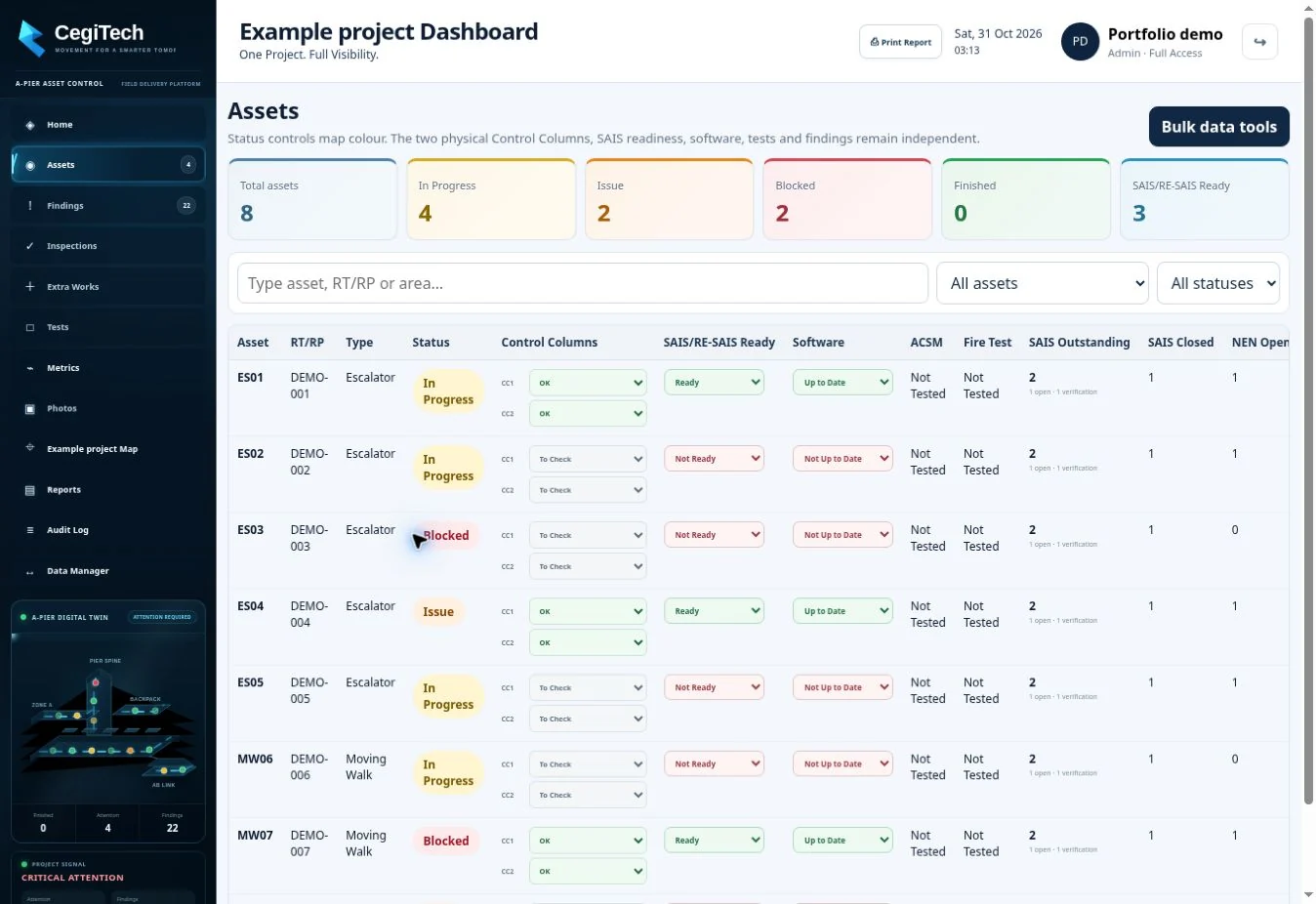
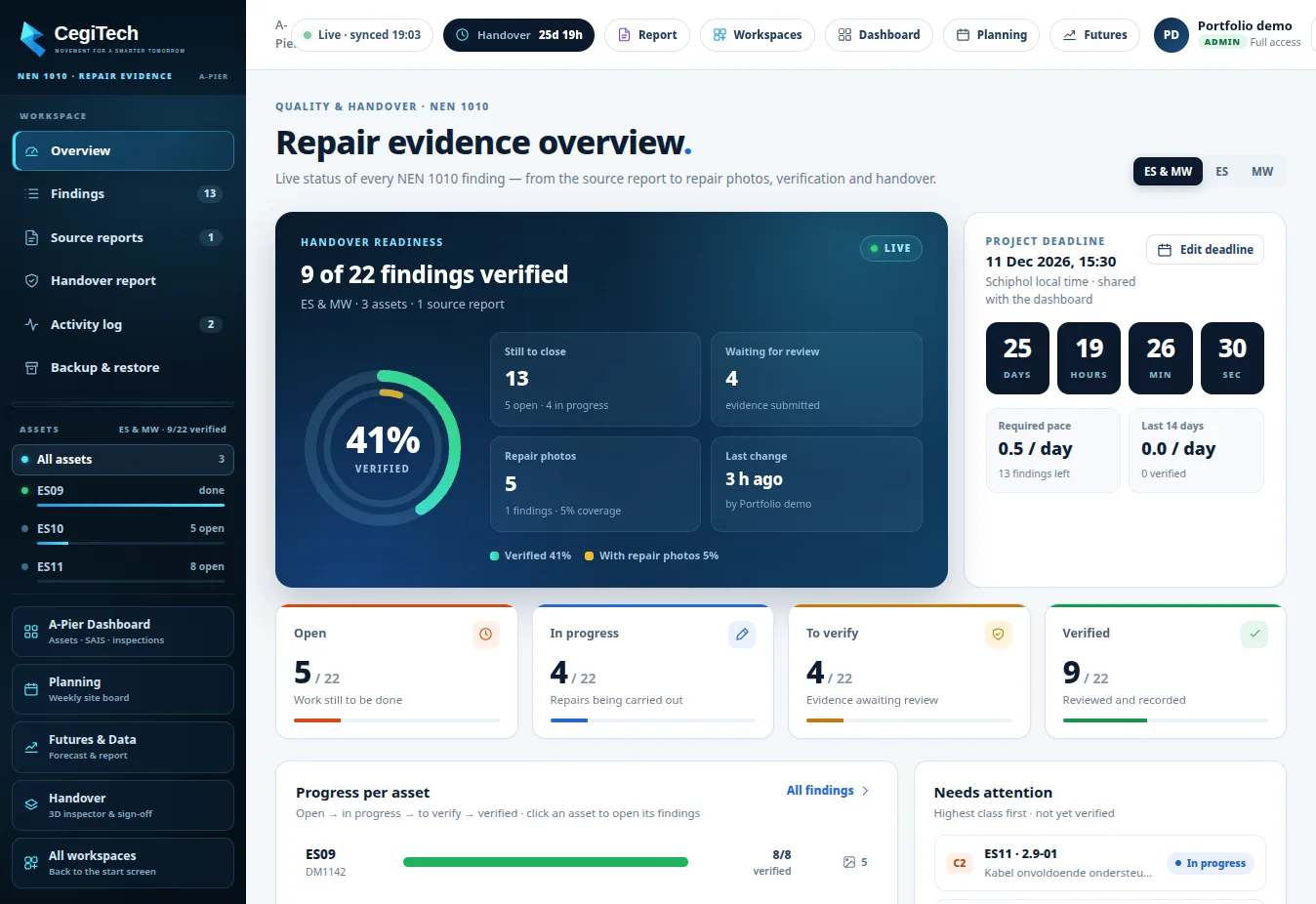
The dashboard grew out of the need to keep a complex close-out scope understandable at asset level. It brings execution status, inspection readiness, software, tests, outstanding findings and responsibility streams into a connected workspace.
The problem it addressed
An overview can become misleading when physical completion, a passed test and a closed finding are treated as one status. Different contractors also need to see their own scope without losing the relationship to the installation and overall delivery.
How it works
Each asset has its own record. The interface separates working status from SAIS/Re-SAIS readiness, software and technical tests. Findings can be followed by asset and responsibility stream, including SED and construction. Additional work, inspection records, photographs and activity history provide supporting detail.
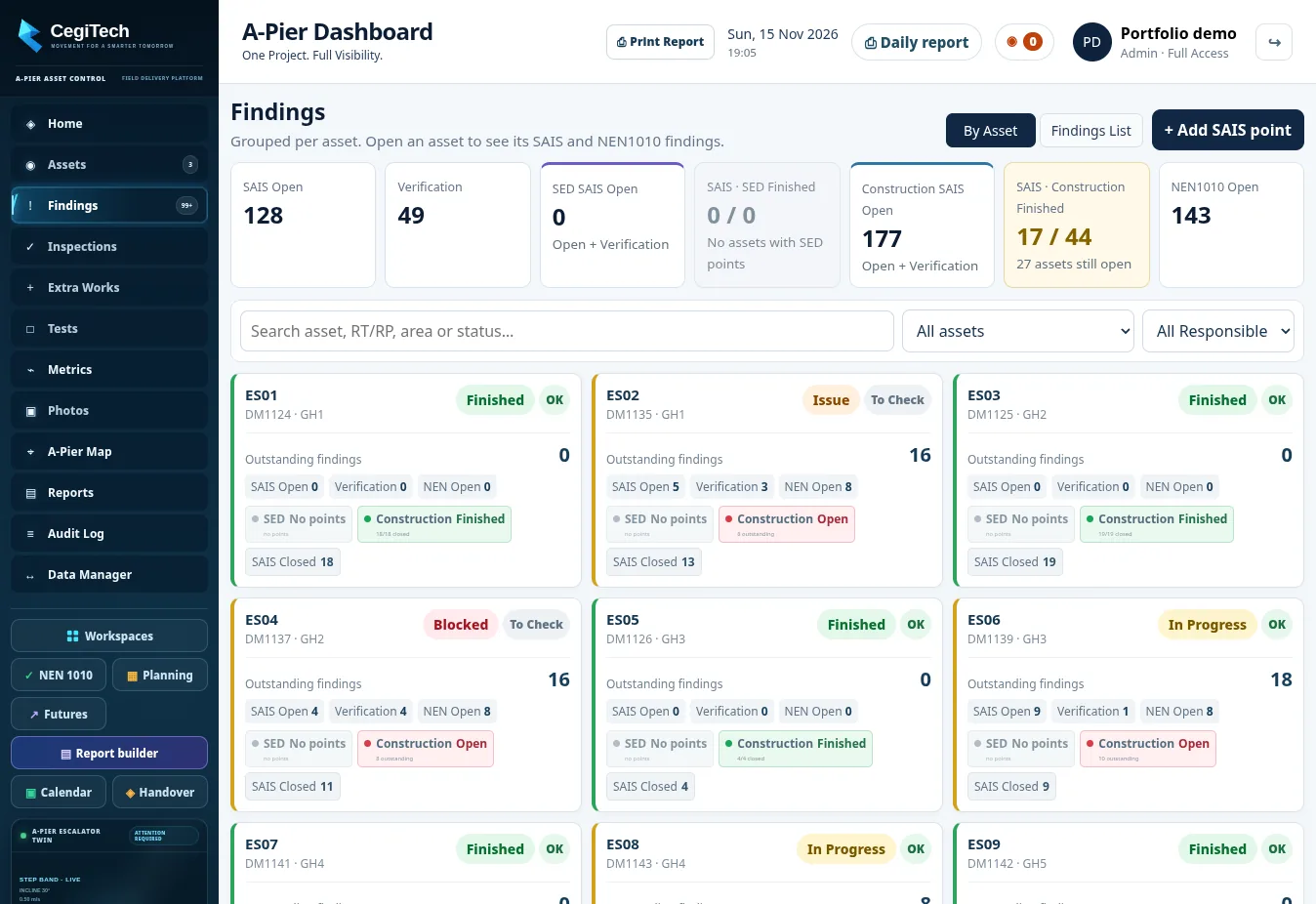
The findings view groups outstanding SAIS and NEN1010 points per asset and splits them by delivery stream, so SED and construction each see what is still open on their side, what is waiting for verification and which assets are already clear.
Findings per asset & stream · demonstration dataView larger
How it supported my project work
It gave me a structured basis for preparing priorities, reviewing outstanding work and generating asset-level reports. Separate status fields helped explain which part of the delivery process still needed attention, while responsibility streams helped organise follow-up with the relevant teams.
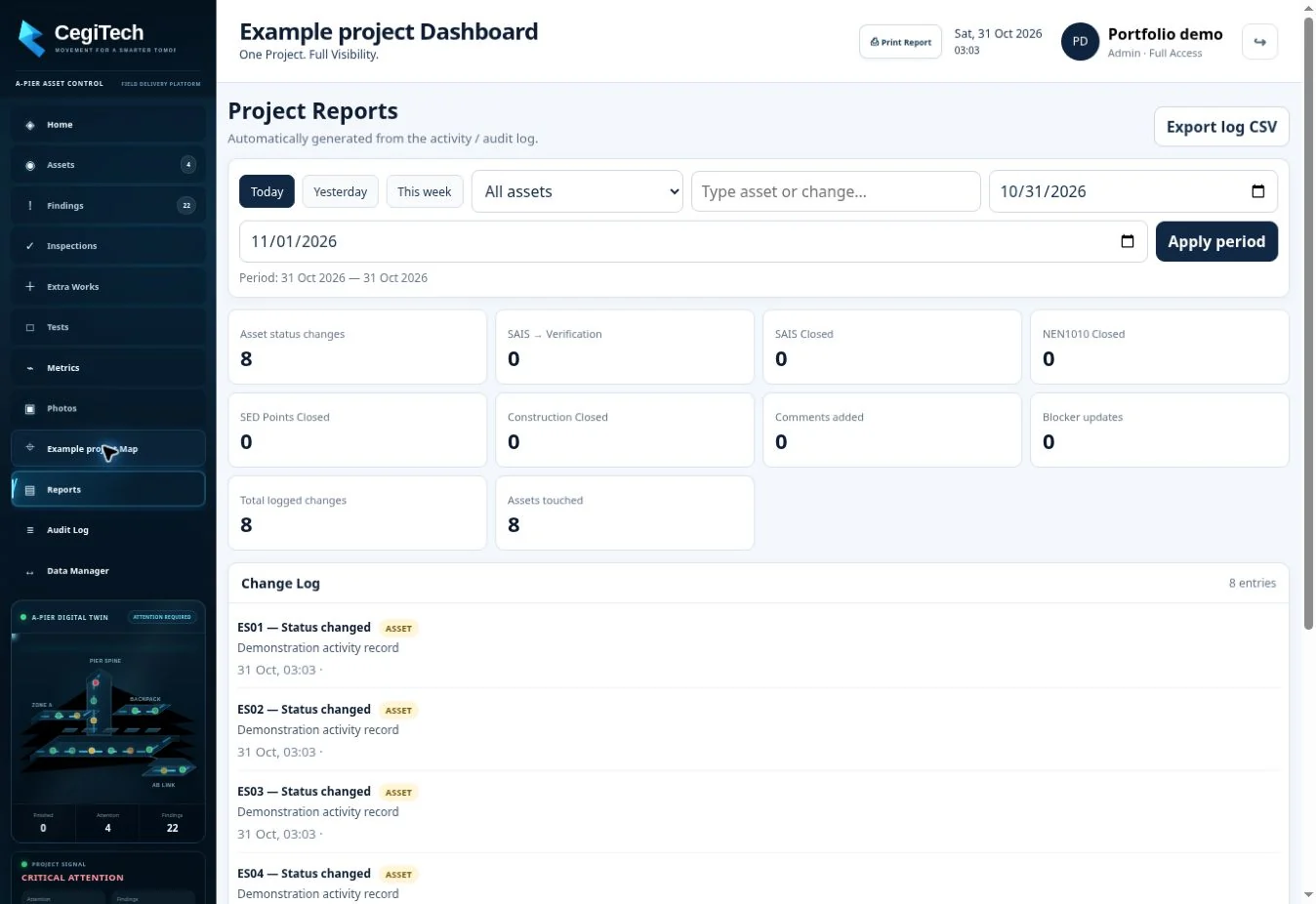
The reporting module turns the recorded activity into a view of what changed during a selected period. It connects the current position with the updates behind it, using the same asset references as the operational dashboard.
What the report contains
Filters allow a focus on a reporting period or an individual asset. The overview groups logged status changes, findings moved to verification or closed, comments and blocker updates. A detailed change log provides the underlying entries, and the view can be printed or exported for further use.
Why this matters for coordination
Regular updates are more useful when they can be related to specific work and records. The module supports preparation of progress conversations and helps me review which assets changed, which points moved forward and where follow-up is still required.
Recorded updates become a reusable reporting source. This supports more consistent preparation and keeps a link between a progress statement and the activities recorded against the asset. The usefulness of the report depends on keeping those underlying records current.
NEN1010 · INSPECTION FINDINGS & REPAIR EVIDENCE
NEN1010 evidence & report application
Working application prototype
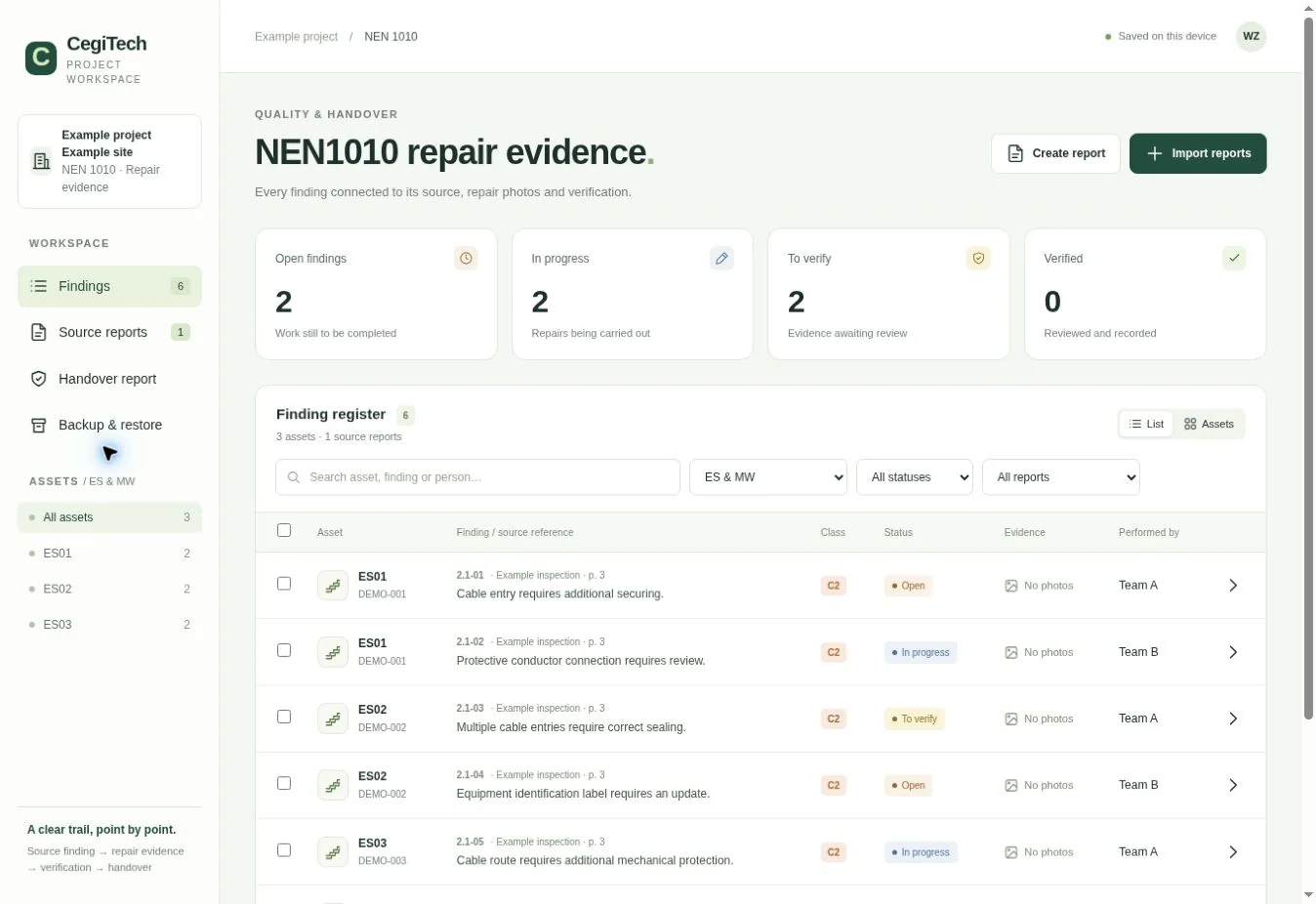
I developed a dedicated workspace for following inspection findings from the source report to the repair record and supporting evidence. It addresses a practical close-out problem: photographs and updates need to remain connected to the correct asset, finding and source reference.
Source reports are imported and findings are organised by asset, with their original section and page references. A repair record can include the work description, person, date, photographs and verification information. Open work, work in progress, evidence awaiting review and verified findings remain separate states.
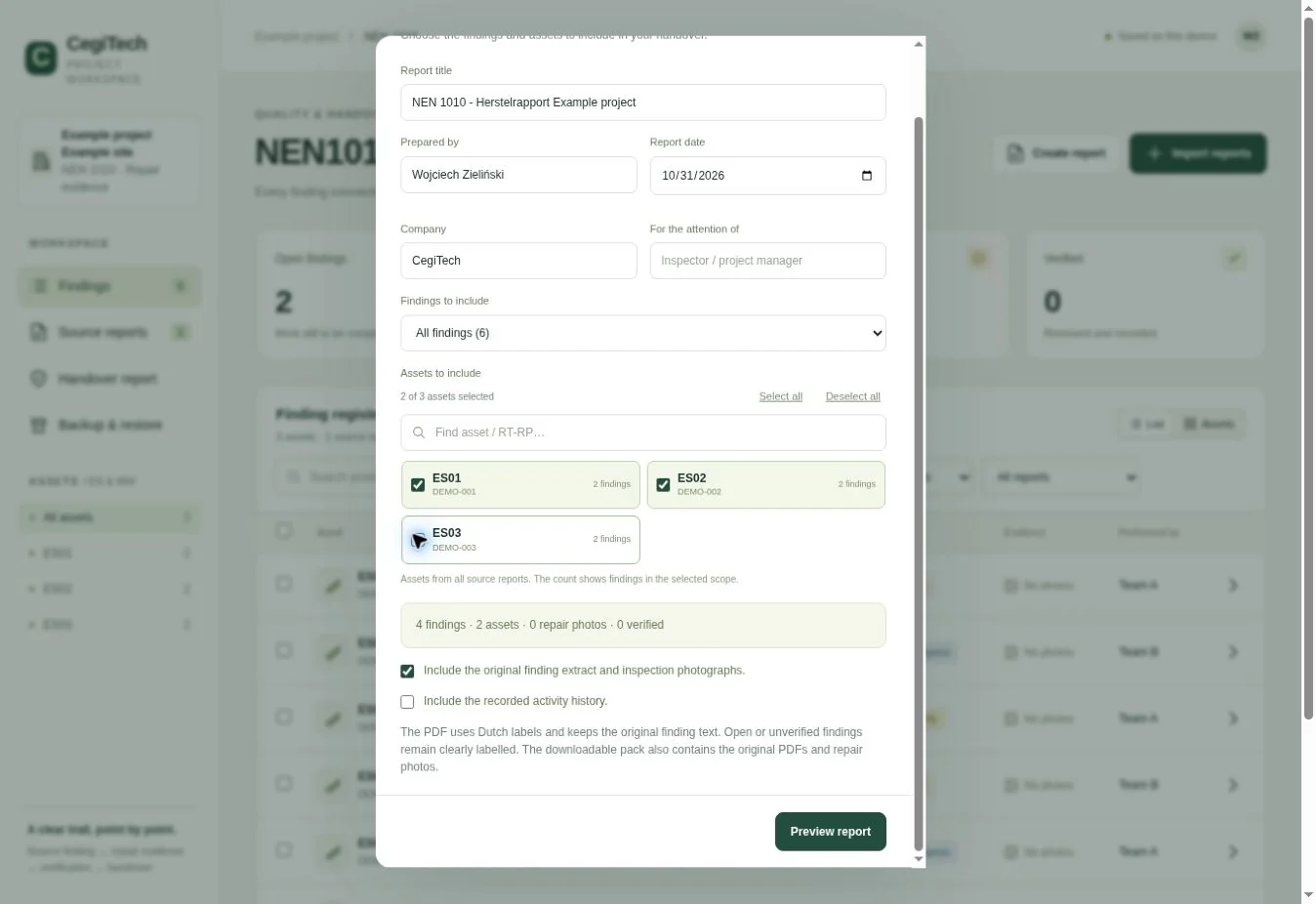
The report creator includes an explicit asset selection, so the report can cover the installations relevant to a particular delivery. The selected scope can be combined with finding filters and supporting records, bringing source references, repair information, photographs and verification status into a reviewable handover report.
Report creator with asset selection · demonstration dataView larger
How it supports close-out
The workflow makes the relationship between a reported defect, the repair and the evidence explicit. It is designed to reduce ambiguity during review and make the required records easier to assemble. Verification remains a distinct step; attaching a photograph does not itself establish formal acceptance.
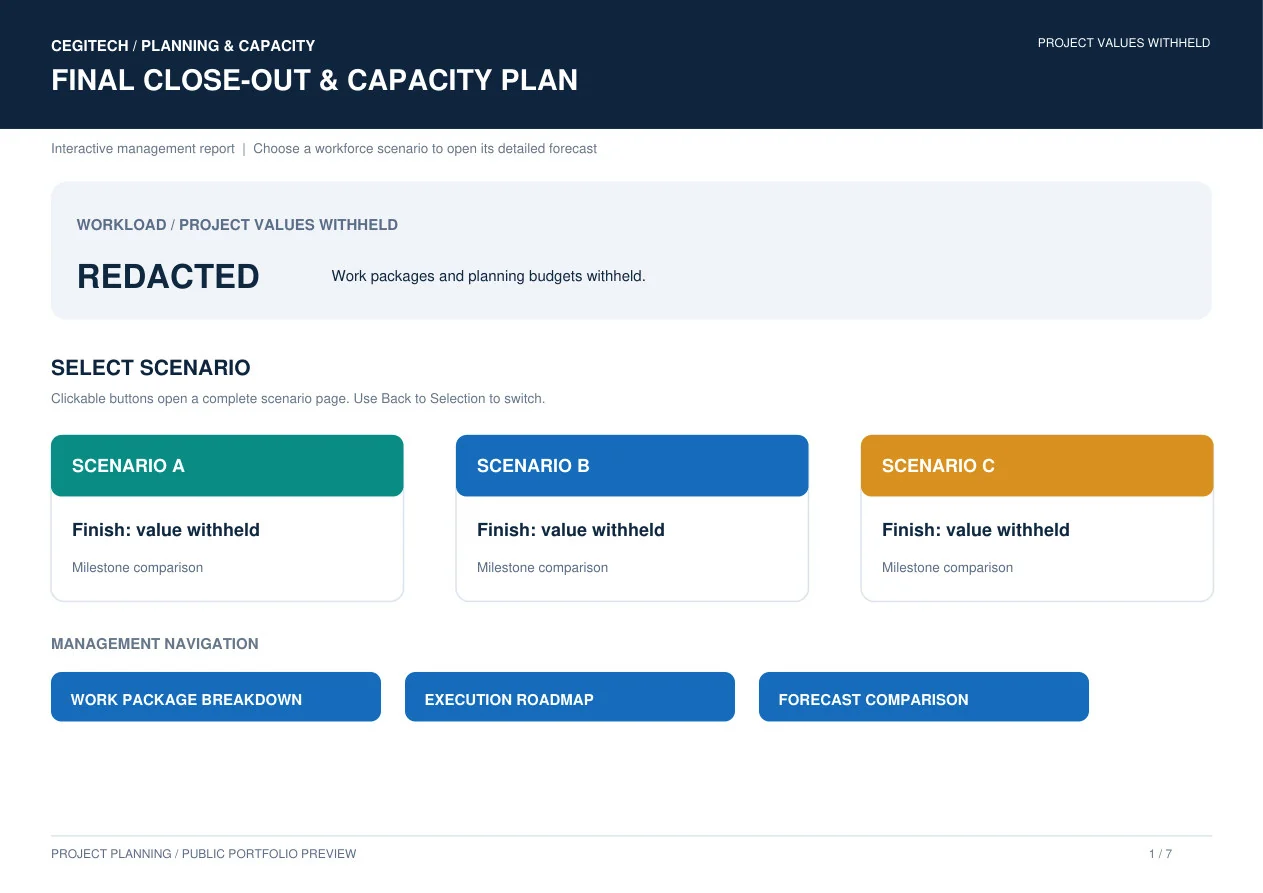
My planning tools connect the remaining scope with the people, hours and conditions needed to deliver it. They make resource discussions more specific by showing how a workforce scenario changes the available capacity and the earliest labour-based completion forecast.
The question behind the model
A target date needs a practical explanation of how it can be reached. The report starts with a defined workload, separates its work packages and compares that scope with the productive capacity of different team sizes.
How the report is organised
The management report includes a scenario-selection page, a detailed forecast for each scenario, a work-package breakdown, an execution roadmap and a comparison of the forecasts. Internal navigation connects these views, allowing a discussion to move between the summary and the assumptions behind it.
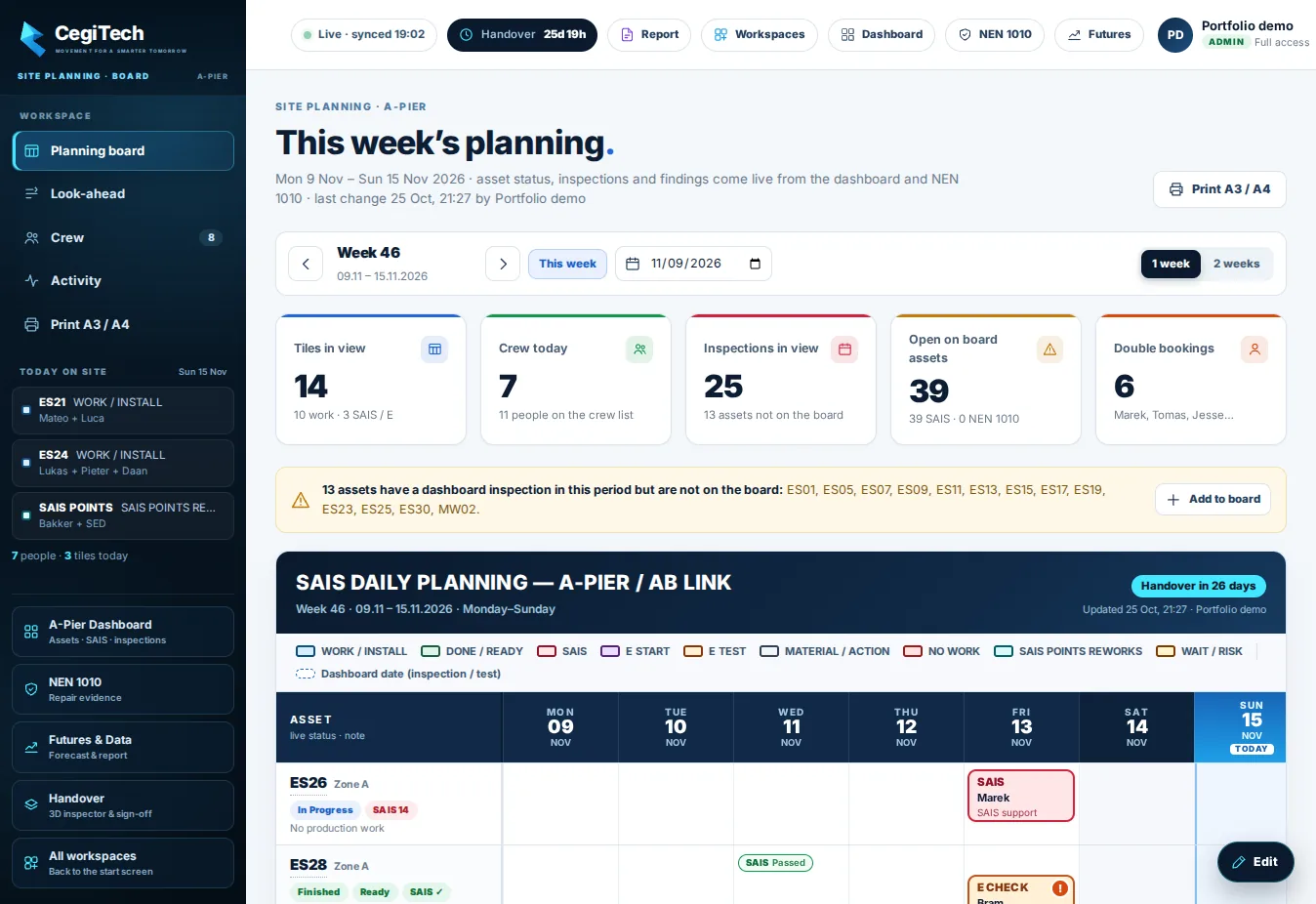
Alongside the management report, the Planning workspace holds the shared weekly wall board. Every asset row shows who works where on which day, with SAIS days, E-tests and rework blocks, while asset status, inspections and findings come in live from the Dashboard and NEN1010. Assets with an inspection but no planned work are flagged automatically.
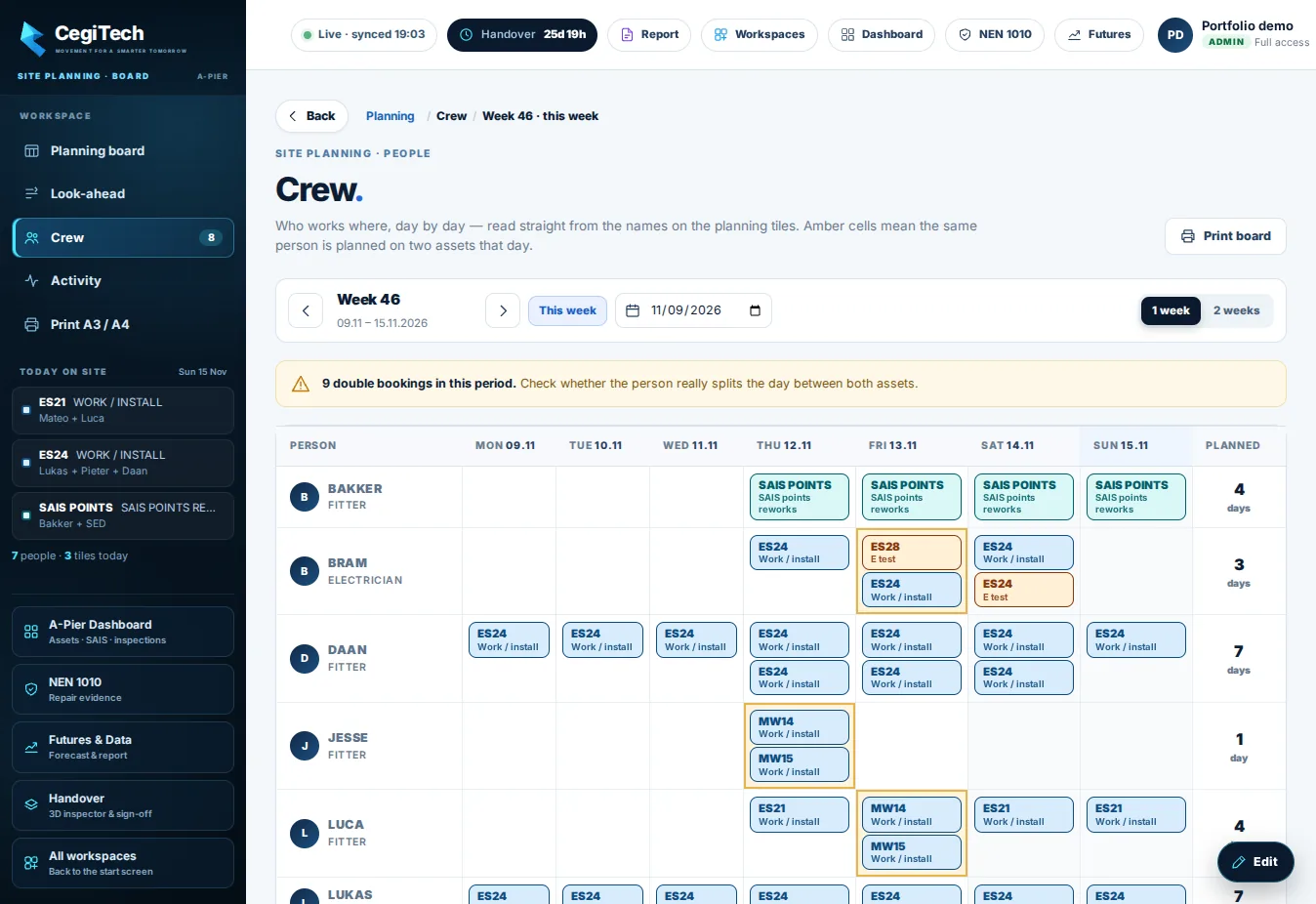
The same board can be read per person. The crew view shows each team member’s week, the assets and activities assigned to them and the number of planned days, and highlights double bookings so they can be resolved before the work starts.
Break the remaining work into explicit budgets and categories, so that base execution, electrical corrections, supporting activities and contingency can be discussed separately.
Workforce scenarios
Compare staffing options using the same workload and stated productive-hours assumptions. Show the resulting capacity, duration and shortfall against a target.
Execution roadmap
Connect workfront priorities with deliverables, technical tests, inspection requirements, material availability and the activities of other contractors.
Management interpretation
Explain what the forecast means and which conditions it excludes. Labour capacity is one part of the assessment; access, materials, specialist support, rework and verification also affect delivery.
How it supports project decisions
The report gives a concrete basis for discussing resource needs, priorities and recovery actions. It makes the relationship between scope, staffing and time visible, while preserving the distinction between a capacity forecast and a confirmed handover date.
Futures & Data is one of the connected workspaces in the CegiTech application. It combines the operational information in the Dashboard, NEN1010 and Planning with a work-package model, producing a connected view of remaining workload, available capacity, forecast dates and asset-level risks.
From separate updates to a connected forecast
The Dashboard supplies asset status, SAIS findings, inspections and tests. NEN1010 supplies inspection findings, repair progress and verification. Planning supplies the people assigned to work fronts and days. Futures & Data brings those sources together and recalculates as the underlying records change.
The workspace focuses on escalators and moving walks. Its four sections are Summary report, Workload, Asset forecast and Data & trends, with an A4 print view for management reporting.
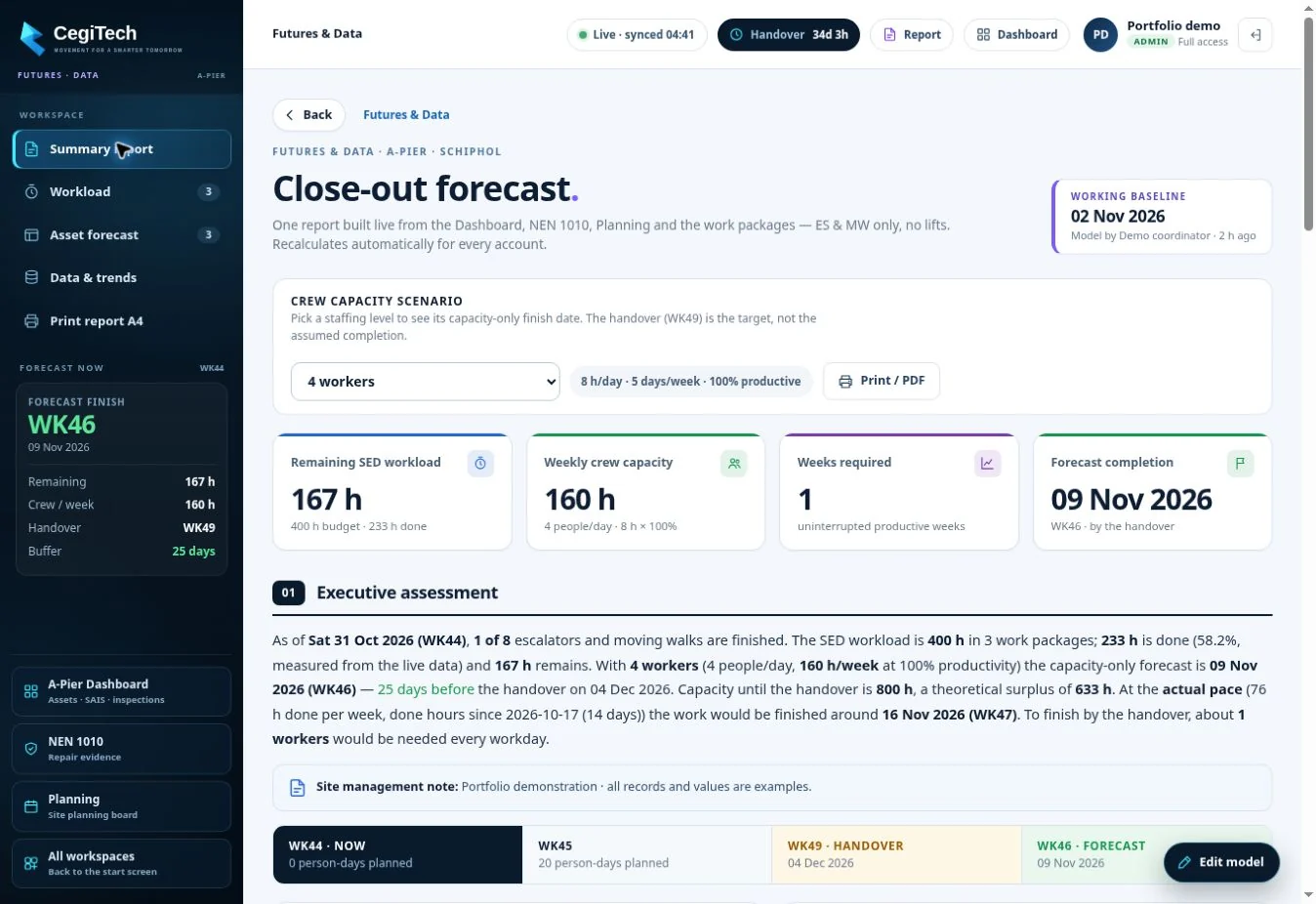
Futures & Data · summary report · demonstration dataView larger
Work packages with an explicit basis
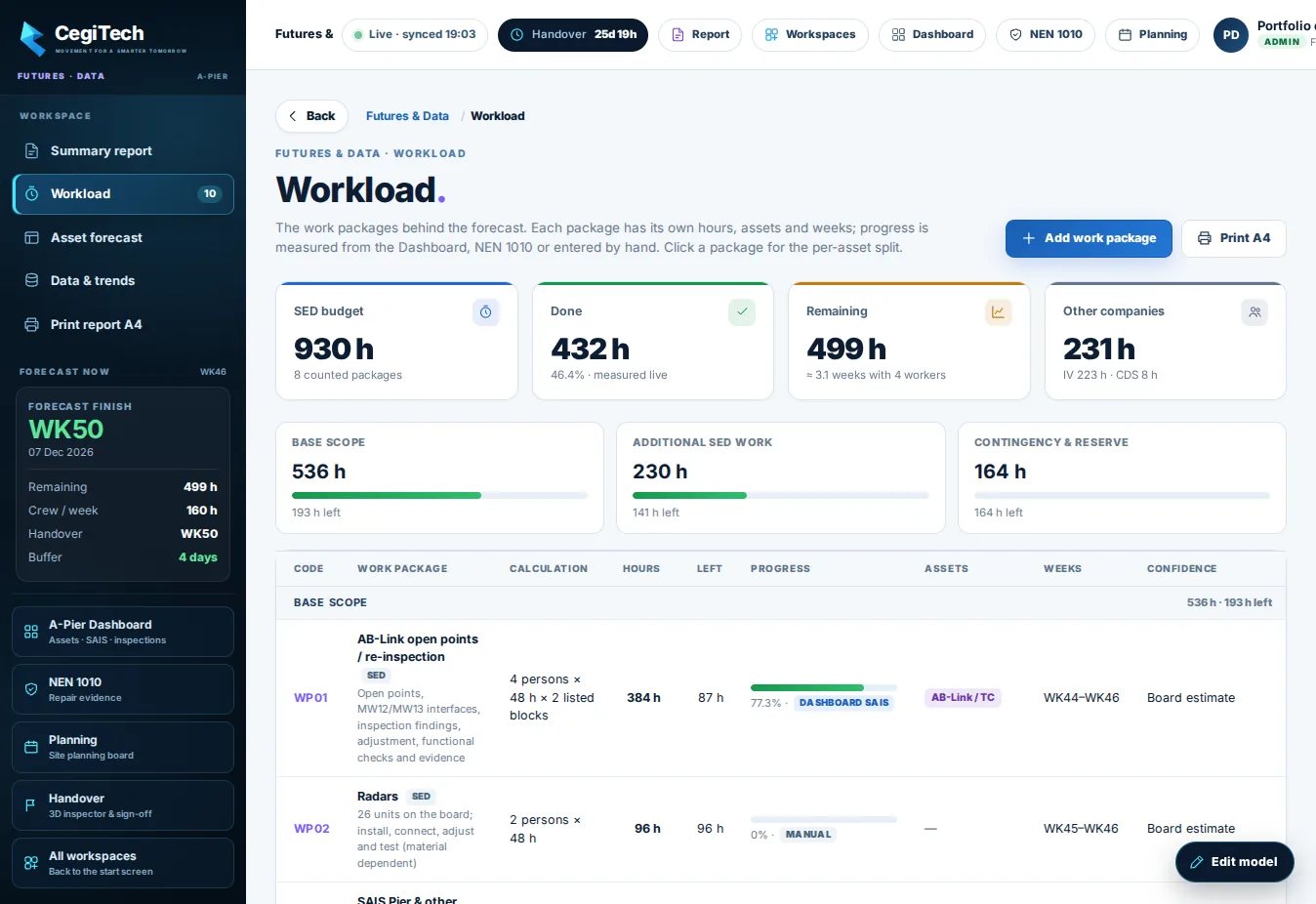
Each package can carry its own hour budget, owner, covered assets and execution weeks. Progress can be entered manually or linked to changes in SAIS points, NEN1010 findings, technical tests or finished assets. This keeps the remaining-hours model connected to the records behind it.
Workload & work packages · demonstration dataView larger
Staffing scenarios and completion dates
The forecast can use the crew recorded on the Planning board or an alternative staffing scenario. Working hours, workdays and productive capacity are stated as model assumptions. The comparison shows available hours before the target, a surplus or shortfall and an earliest capacity-based finish date. A custom crew size lets the reader explore another option without changing the shared plan.
The report also shows the actual closing pace from recorded progress. Keeping that view separate from theoretical capacity helps frame a more useful discussion about resources, delivery conditions and the remaining work.
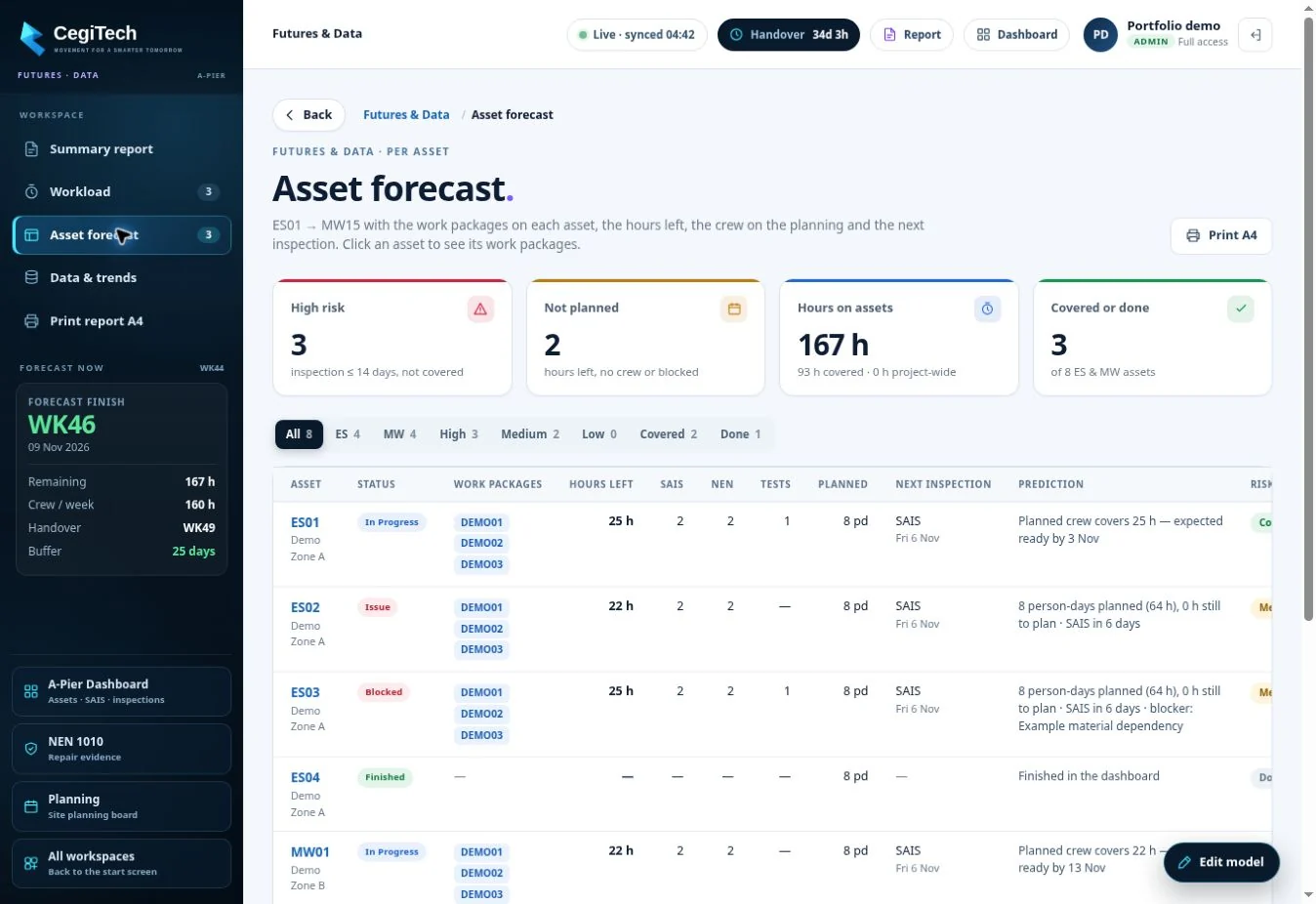
The asset forecast connects the hours remaining on an installation with its work packages, outstanding findings, tests, planned person-days and next inspection. Risk signals draw attention to work that lacks planning coverage, upcoming inspections and recorded blockers. The reader can move from the summary into the underlying package or asset detail.
Trends, reporting and controlled access
Daily snapshots and recorded closing dates support views of remaining work, progress and changes over time. The summary can be printed in A4, while the application’s roles keep model and work-package editing with administrators. Viewers can read the report, explore scenarios in their own view and print it.
How it supports delivery decisions
Futures & Data turns information from the three operational workspaces into a structured basis for discussing staffing, priorities, recovery actions and the next delivery milestone. It connects a forecast with its workload and assumptions, while keeping material availability, access, testing and verification visible as conditions for actual completion.
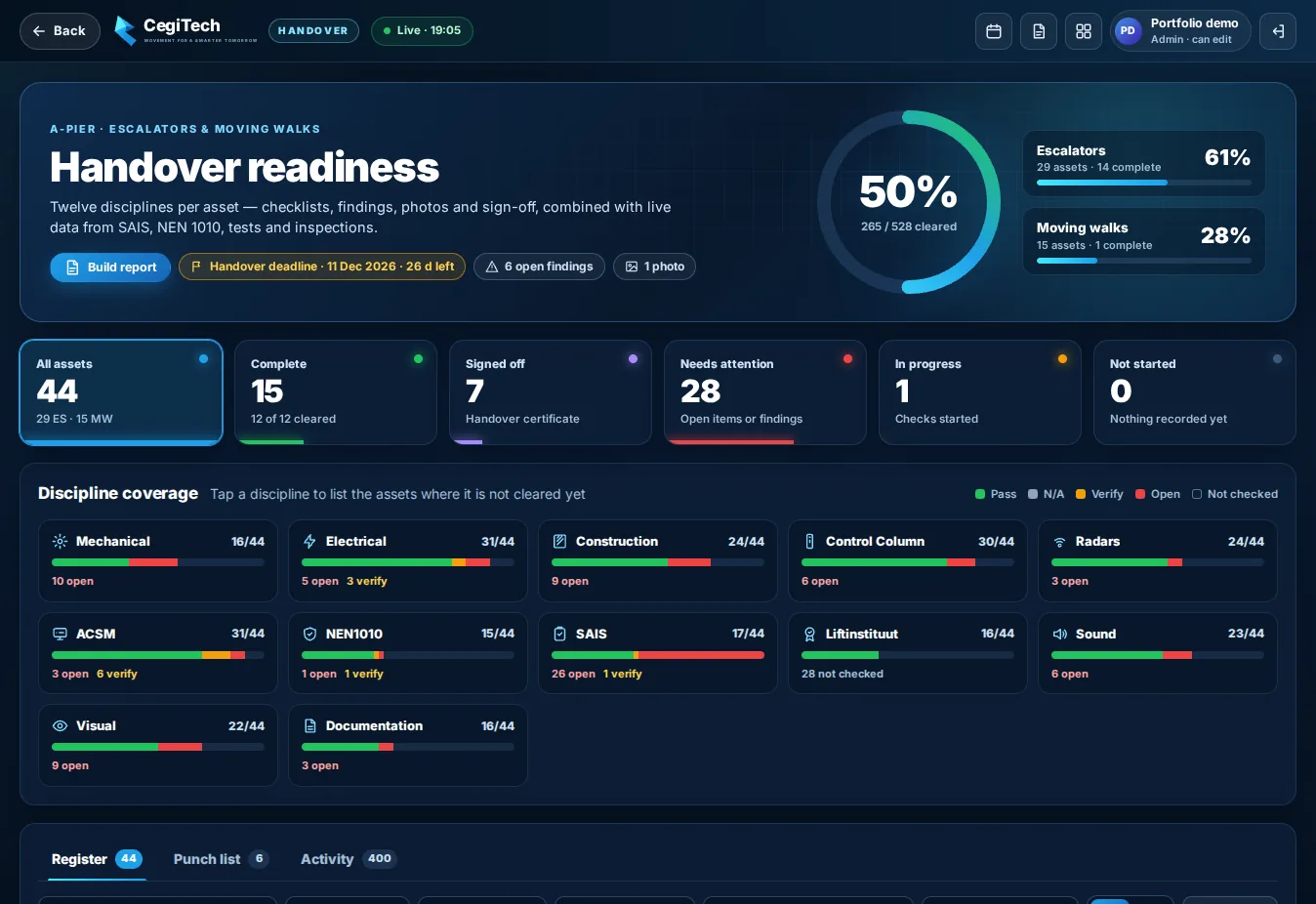
Handover is the newest workspace in the CegiTech application. It turns “ready for handover” into something that can be checked: every escalator and moving walk is assessed across twelve disciplines — mechanical, electrical, construction, control column, radars, ACSM, NEN1010, SAIS, Liftinstituut, sound, visual and documentation.
Readiness across the whole scope
Each discipline has an editable checklist, findings, photographs and notes. The overview combines these records with live data from SAIS points, NEN1010 findings, technical tests and inspections, showing how many disciplines are cleared, which assets need attention and where each discipline still has open points.
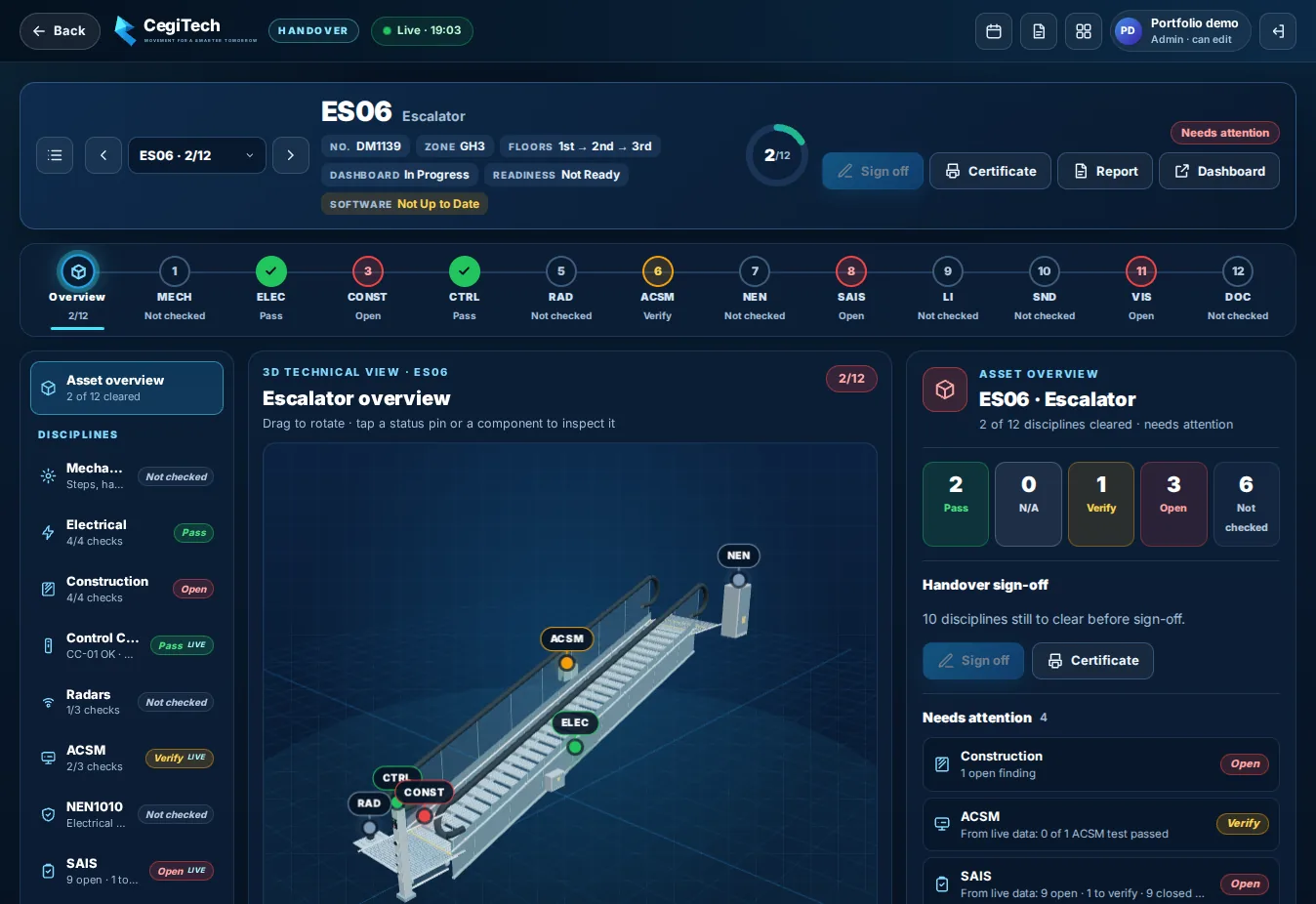
Opening an asset shows a 3D technical view of the escalator or moving walk with a status pin for every discipline. Tapping a pin or component opens the related checklist. Answers are recorded as OK, NOK or N/A, and a NOK item or an open finding keeps the discipline open.
Live data can also hold a discipline back: if a discipline is marked as passed while SAIS points or NEN1010 findings are still open, it moves to verification instead. Sign-off and the handover certificate only become available when all twelve disciplines are cleared.
3D inspector per asset · demonstration dataView larger
A report for the scope being handed over
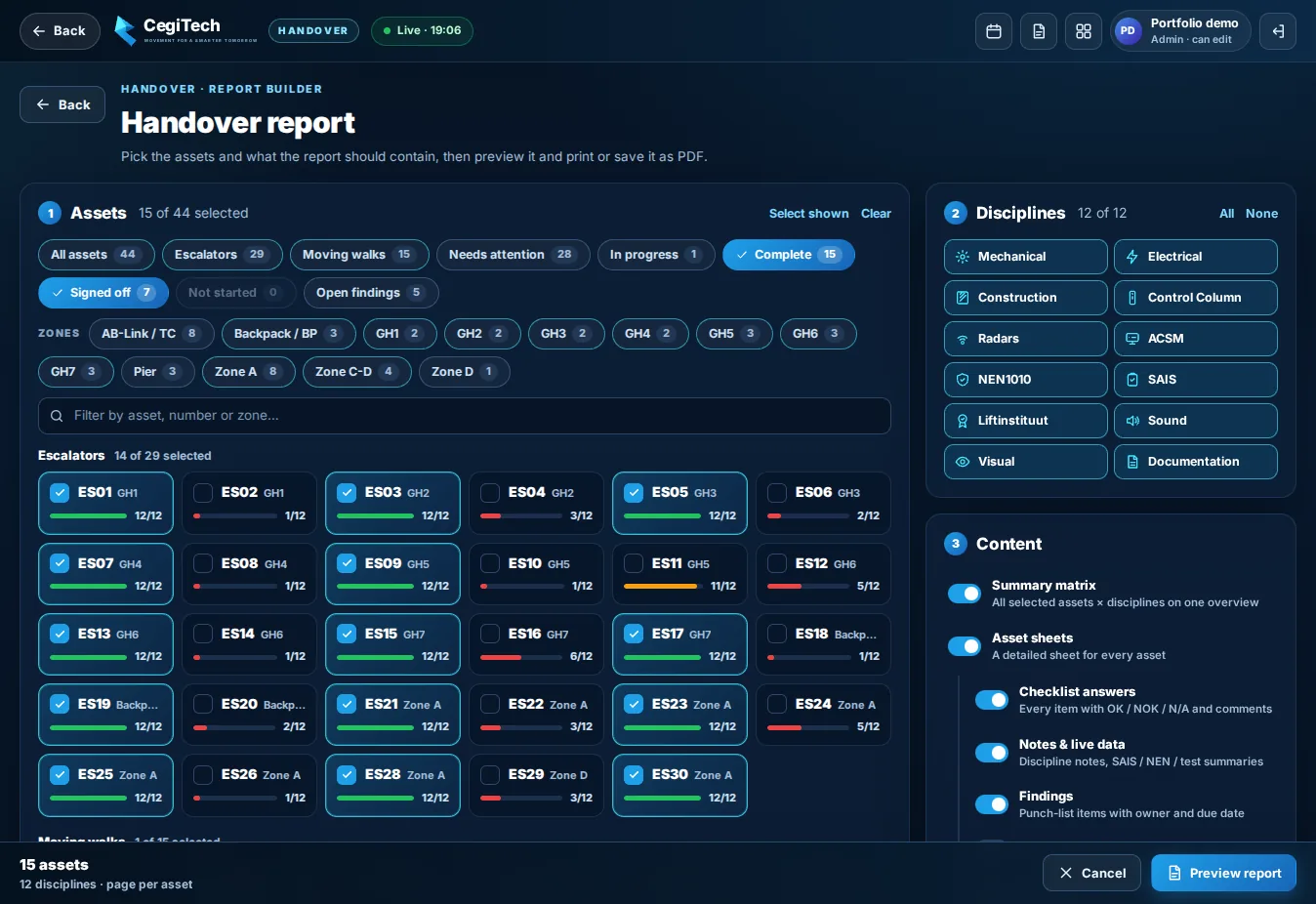
The report builder lets me select assets by status, zone or type, choose the disciplines and decide what the report should contain — a summary matrix, an asset sheet per unit, checklist answers, notes and live data, findings and photographs. The result can be previewed and printed or saved as a PDF.
The workspace makes the remaining work before handover visible per asset and per discipline. It separates the checks recorded by the team from the evidence coming in from the other workspaces and prevents an asset from being signed off while something is still open. The result is a reviewable record for every unit that can be shared with the client.
I am looking for ZZP and project-contract opportunities where I can combine site leadership, coordination and analytical thinking — and take broader responsibility for how the work is organised and delivered.
Build on practical experience and expand the scope.
My next step is about contributing across more of the delivery process. I want to stay connected to execution while taking a wider role in planning, resources, interfaces, client requirements and the information needed to control progress.
The foundation is already practical: leading teams, organising work and coordinating technically demanding activities. My analytical background adds the ability to structure a complex workload, question assumptions and present the implications of different choices. Together, these strengths can support a broader contribution than an isolated work package.
Site management
Responsibility for the way work gets delivered
I am interested in assignments where I can organise site activities, lead teams and coordinate subcontractors, with a clear mandate to address day-to-day delivery issues. Planning, quality, safety, materials and the sequence between trades need to be considered together.
Project coordination
A stronger connection between all parties
I want to work at the interface between the client, project team and contractors, translating requirements into coordinated actions. I can contribute where several scopes meet and where progress depends on clear responsibilities, timely information and consistent follow-through.
Project control
Better visibility of time, resources and progress
I want to develop further responsibility for programme, capacity and cost awareness, connecting operational information with project decisions. My experience with workload planning, status tracking and reporting gives me a practical base for this direction.
Digital delivery
Useful tools built around the people doing the work
I am interested in project environments where structured information and practical technology can improve coordination. I bring experience developing tools from site needs and can help identify where a clearer register, report or workflow would support delivery.
Project environments I want to contribute to.
My experience in airport infrastructure, data centres, building works and commercial renovation gives me several starting points. I am open to further assignments in commercial buildings and fit-out, infrastructure and technical facilities, industrial and data centre projects, and energy or industrial-installation environments.
For each opportunity, the important question is how my experience matches the scope, team and responsibilities. I am interested in projects where practical judgement, coordination across disciplines and disciplined follow-up can make a useful contribution.
How I want to work with the next team.
I value a clear scope, understandable responsibilities and direct communication about the project’s priorities. I am willing to take ownership of the work within my mandate and want the room to improve how the team organises information and follows progress.
I am based in Rotterdam and bring international construction experience, with fluent Dutch and English alongside native Polish. My focus is freelance cooperation through ZZP and project-based contracts. A useful first conversation can start with the project phase, the delivery challenge and the responsibility the team needs someone to take.
Let’s discuss the responsibility your project needs.
Site management · project coordination · project control · ZZP contracts
Start with the challenge. Define the contribution.
If your project needs practical site leadership, coordination across teams or a more structured view of delivery, I would welcome a conversation about the scope and responsibility.
Useful starting points are the project’s current phase, the work that needs to be organised, the parties involved and the next delivery milestone. From there, we can discuss how my construction experience, coordination and analytical capabilities fit the assignment.